
World Time Zones
UTC Time Scale
Coordinated Universal Time (UTC) is an internationally agreed time scale based on atomic time (TAI) supplemented with leap seconds to maintain synchronization with the irregular rotation of the Earth. We can think of it as "world clocks" and the basis of civil time. It is coordinated and maintained by the International Bureau of Weights and Measures (BIPM) and is based on atomic clocks. However, it is not purely atomic time, as it also includes irregular leap seconds, added to keep it synchronized with the irregular rotation of the Earth and the astronomical time UT1.
Leap second is a one-second adjustment irregularly applied in the UTC time scale so that the difference between the astronomical time UT1, affected by the irregular rotation of the Earth, and UTC is smaller than ±0,9 s.
The creation of UTC involves around 80 national metrological institutes, which provide their time data and compare their time standards with others. BIPM calculates UTC from comparisons of over 450 atomic clocks and 12 primary frequency standards operated in these institutes. UTC is thus calculated retrospectively and the calculations are published monthly in the BIPM Circular-T report. In practice, it is realized through national time standards, which are coordinated and compared with UTC.
UTC time is not practical to use globally. Depending on the geographical longitude, for example, noon when the sun is highest might not correspond to 12:00, but rather to an earlier or later hour. Such a system would not be practical. In the following decades, time zones were thus introduced globally. These allowed individual regions of the Earth to adjust UTC by agreed-upon time offsets so that they better corresponded to the local day and night cycle. Within a single time zone, the time is the same, and when crossing into a neighboring zone, it usually changes by one hour. (In practice, there are also several time zones that differ by a fraction of an hour, but the principle remains the same.)
UTC(SMU)
UTC(SMU) time scale is the physical representation of the UTC time scale generated by the primary time and frequency standard at SMÚ - cesium atomic clocks, currently of type HP 5071A. Since 1997, it has been declared as the national time and frequency standard NE 004/97, the highest metrological level standard, which is placed at the top of the time and frequency measurement traceability scheme in Slovakia.
Generally, each such standard consists of:
- main oscillator source of a periodic electronic signal that has an a priori unknown fractional offset
- counter / frequency divider each observation of the fundamental frequency
- reference point 3 conventions defined by the local laboratory
- time scale dissemination dissemination of the UTC(k) time scale to BIPM, with all delays from the reference point UTC(k) compensated. BIPM publishes the Circular-T report monthly, from which the frequency offset
- time scale coordination minimization, if it is in the interest of the laboratory, of the difference UTC-UTC(k) and/or improvement of the stability of UTC(k) by adjusting the frequency deviation of the main oscillator
|y| << 1
from the nominal frequency f0, but which is continuously operating and is continuously and indefinitely observable.
The fractional frequency offset y is defined as (f-f0)/f0
f0 Hz cycles of the UTC(k) time scale main oscillator indicates a time interval of 1 second.
The electronic counter/divider accumulates this phenomenon by generating a signal,
ideally a fast rising voltage pulse for achieving high resolution.
k determine the definition of UTC(k) with respect to the periodic electrical signal of the counter/divider:
physical location, measurement protocol, and relation to UTC.
Since the speed of each signal is finite, it is necessary to define a reference measurement point (e.g., connector), its physical location for comparing UTC(k).
All other transmissions and comparisons of the signal must take into account subsequent signal delays.
And since signals are emitted with finite impedance and finite bandwidth, it is necessary to adopt a convention
establishing the moment that denotes the periodicity of the signal at the reference point (e.g., voltage trigger level).
And finally, it is necessary to adopt the fact that an electronic pulse will forever be associated with a (time) tag denoting an integer second in the UTC time
scale regardless of the existence or creation of any fractional second difference |Δ| << 1
between UTC(k) and UTC.
The number of pulses from this reference pulse produces the denoted second in the UTC(k) time scale.
y and time scale offset Δ can be obtained.
y
or compensating the offset.
International comparison
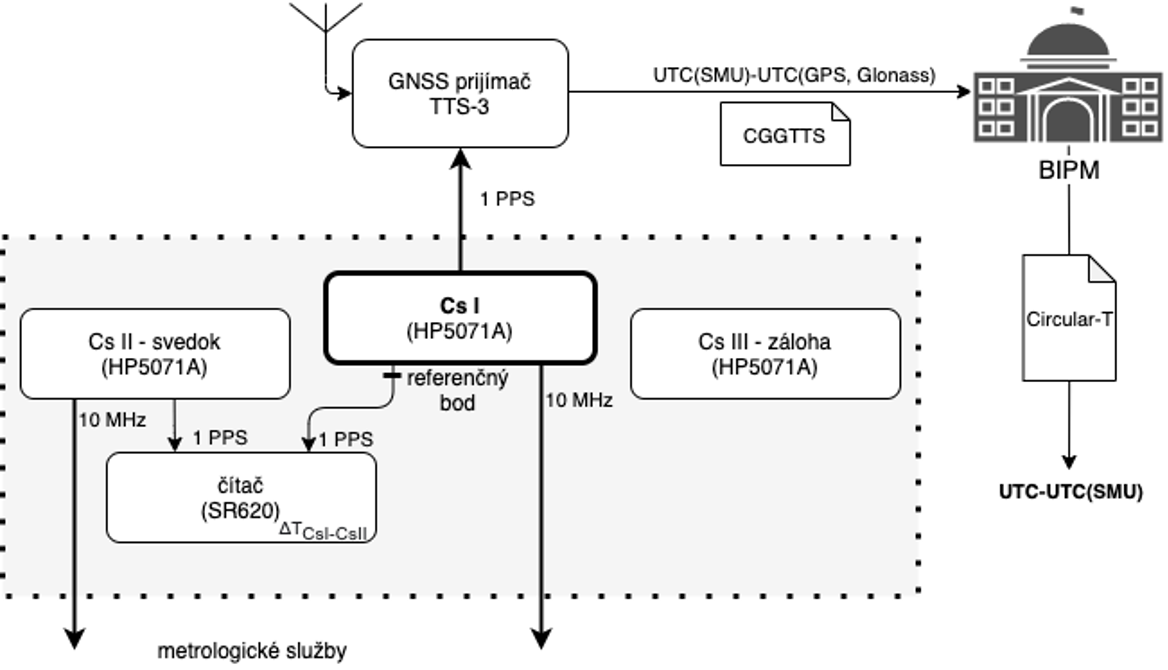
International comparison of time standards is a significant part of the system for creating the world's standard value of the time unit. The comparison is organized as a continuous service, because time is a continuously flowing unit. Currently, the comparison is mainly performed using a auxiliary reference signal. The use of a generally available or specially created auxiliary signal provides the possibility to organize continuous comparison of several standards at the same time and also eliminates the need for transporting standards, which can introduce additional errors. For comparison, the GPS GNSS system is currently used in SMÚ when utilizing the Common-View method.
Second
The second is the base physical unit of time in the
SI
system of units, which is based only on natural constants. The symbol for the second is the lowercase letter s,
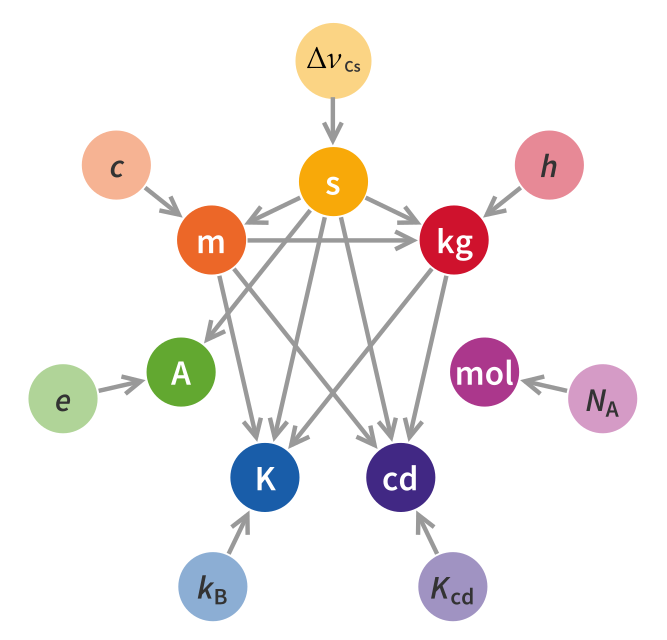
The second is defined by a fixed numerical value of the cesium frequency, ∆νCs, the transition frequency of the cesium-133 atom in its ground state at absolute zero temperature, equal to 9 192 631 770, when expressed in the unit Hz (hertz), which equals s-1.
1 s = 9 192 631 770 / ∆νCs,
where ∆νCs is a natural constant.
The consequence of this definition is that the second is equal to the duration of 9 192 631 770 periods of radiation corresponding to the transition between two hyperfine levels of the ground state of the cesium-133 atom in its rest state. The reference to the rest state of the atom is intended to emphasize that the SI definition of the second assumes an isolated cesium atom at absolute zero temperature, which is not affected by any external field.
The current definition was adopted in 1967, revised in 2019 and allows for very precise time measurement, which is independent of astronomical phenomena and can be realized using atomic clocks. Thanks to this definition, we achieve high accuracy and stability in time measurement, which is crucial not only for scientific research but also for many applications including navigation, telecommunications, electrical power grids, or the financial sector.
Among the SI units, the second has a distinguished position. Except for the unit of amount of substance, the mole,
all other SI units depend on the second. The uncertainty of its measurement directly enters into the uncertainty of measurements of other units.
Dissemination of Time
Dissemination of time is the way we can transmit information about the current time from one place to another. Currently, among the most common methods of time dissemination are:
- global navigation satellite systems (GPS, Galileo),
- telecommunications networks (GSM networks of mobile operators, or data networks using NTP and PTP protocols),
- radio signals (e.g., DCF77 transmitter in Germany with a range up to Slovakia),
- dedicated satellite links (TWSTFT - Two-Way Satellite Time and Frequency Transfer),
- (dedicated) optical links.
Each of these methods has its own advantages and disadvantages, and is suitable for different applications depending on the required accuracy, availability, and costs. For example, GNSS provide wide availability and excellent accuracy, but are affected by atmospheric (ionospheric) conditions and can be easily disturbed. NTP is a simple and widely used protocol for time synchronization in computer networks, but its accuracy fluctuates depending on network latency and congestion. The dissemination of radio signals on long waves (77.5 kHz at DCF77) has only limited accuracy and range. At greater distances, the time required to cover the distance between the transmitter and receiver varies between day and night.
Therefore, while the first three methods are mainly used by industry, services, and the public, the other two are specifically designed for metrology purposes, for comparing time standards and scientific research.
How to Set Up NTP on Your Computer
Time from the Slovak national time and frequency standard can be obtained through a public NTP server connected to this national standard. On your home computer, you will perform the setup for the operating system
- Windows 11
- in Settings,
- in the Time & Language section → Date & time,
- in the Additional settings
- by filling in the address time.gov.sk to change the time server.
- MacOS
- in System Settings,
- in the Date & Time section
- by setting the Source to time.gov.sk.
- Unix/Linux
- by adding the new NTP server to the NTP service configuration file using a new line
- and restarting the service.
server time.gov.sk iburst
NOTE: The time on work computers is often controlled by a domain server. Therefore, consult with your system administrator or network administrator before trying to change the time server settings.
Know More
If you are interested in the topic and want to know more about time and the realization of the second, we recommend visiting the websites of other institutes, such as:
- BIPM (Bureau International des Poids et Mesures)
- NIST (National Institute of Standards and Technology)
- NPL (National Physical Laboratory)
- PTB (Physikalisch-Technische Bundesanstalt)
If you want to know more about the videos:
- If you want to know more about atomic clocks
- If you want to know more about optical clocks
- If you want to know more about time measurement